I build AI systems that hold up when it matters.
Three years shipping production clinical AI — ambient scribes, RAG pipelines, fine-tuned LLMs, and the evaluation infrastructure that makes them trustworthy. Most of that work happened in healthcare, where a wrong answer isn't a UX bug — it's a patient safety event. Lately I've been building the layer underneath: consensus, queueing, and inference serving, written from scratch and benchmarked.
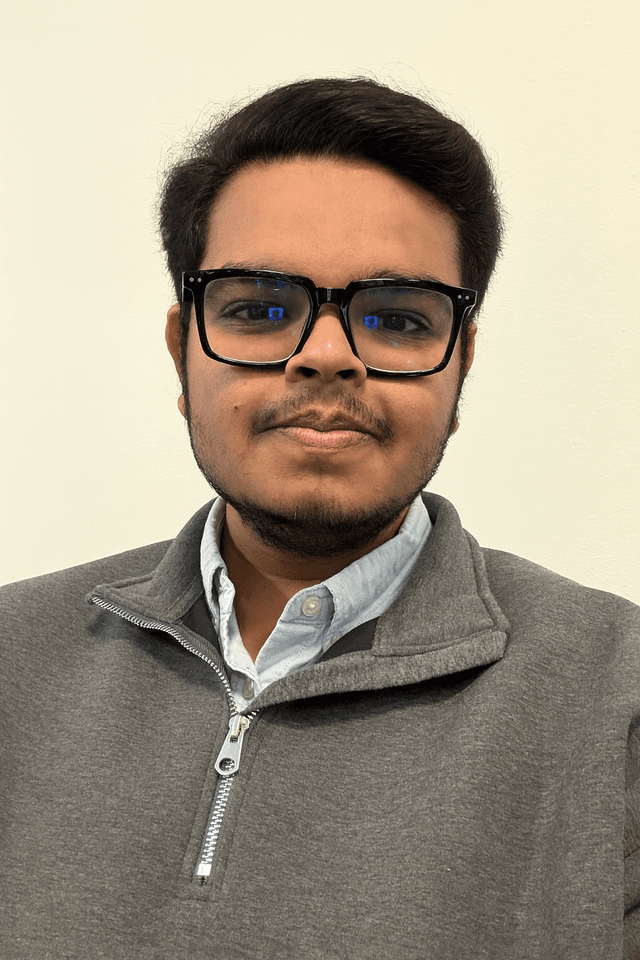
I grew up in Gujarat, India, surrounded by a family that ran a manufacturing business. The problem-solving was always around physical systems — how do you make this process faster, cheaper, more reliable? I think that's where I got the bias toward systems thinking and the reflex to measure everything.
I came to the US for an M.S. in Computer Science at Illinois Institute of Technology, graduating May 2026. The first real production system I touched was a DICOM reporting pipeline at Sarjen Systems — medical computer vision across 200+ hospitals. A 65% throughput improvement sounds like a line on a resume; what it felt like was learning that the gap between "code that works" and "code that works at scale in a regulated environment" is where most of the actual engineering lives.
That shaped everything after. At Leap of Faith Technologies I built QLoRA-fine-tuned LLaMA models for clinical decision support, an agentic triage system, and a RAG pipeline for visit-note-to-EHR matching. At Kinetic Systems in SF I was the sole engineer on an enterprise deployment in a regulated industry, taking it from an undocumented workflow to production in three months.
The research side runs in parallel. I'm a co-author on HealthAdminBench at ICLR 2026 — a Stanford-led benchmark for Computer Use Agents in healthcare administration. The paper surfaces something important: CUAs are already performing administrative tasks in healthcare and nobody has agreed on how to evaluate them. We tried to fix that.
In August 2026 I set out to close the gap between "I use this" and "I built this," and shipped eight systems in a month across four disciplines: Raft consensus from scratch in C++20, a task queue benchmarked across three brokers, a GraphRAG reasoning engine, a sandboxed self-healing code agent, an LLM inference gateway, a streaming orchestrator, and two forward-deployed data systems. Every one carries a spec, a measurement protocol, and a written register of what it doesnotprove. The gateway's headline finding is a negative result that undermines its own feature — I published it anyway, because that's the part worth reading.
Evaluation before optimization
A model you can't measure is a model you can't improve. I spend more time on eval infrastructure than most engineers are comfortable with — it pays off every time.
Ship a tracer bullet first
Before building layers, I build one complete vertical slice: input → processing → output, end to end. It finds the integration bugs that only appear when layers meet.
The bug is almost never where you think it is
In clinical AI, especially. I've learned to distrust the obvious explanation and run the experiment.
Write the README before the code
If I can't explain what a system does in plain English before building it, I don't understand the requirements yet.
Boring tech is usually right
PostgreSQL over a new vector DB. A well-tuned prompt over a complex pipeline. The interesting constraint is the problem, not the tooling.
- Recently shipped an enterprise healthcare deployment at Kinetic Systems as the sole engineer
- Eight open-source systems shipped in August 2026 — consensus, queueing, agent infrastructure, inference serving, and forward-deployed data pipelines
- Closing the measurement gap on those repos: four carry benchmark numbers, the rest stay unnumbered until the number actually exists
- Open to founding-engineer and ML eng roles at applied AI startups, Series A–C
Sole engineer on an enterprise deployment in a regulated industry, working the full path from customer workflow to production. Agentic workflow orchestration, retrieval and context design, document intake and structured extraction, evaluation harnesses for non-deterministic systems, and cloud infrastructure as code.
Fine-tuned LLaMA models for clinical decision support via QLoRA. Built an agentic triage system, a RAG pipeline for visit-note to EHR matching, and productionized LLM services on AWS + GCP.
Refactored a medical computer-vision service for DICOM reporting workflows across 200+ hospitals. Improved throughput by 65%.
Designed and deployed cloud infrastructure on AWS (EC2, S3, Lambda, VPC, IAM) for distributed applications, with multi-tier fault tolerance across load balancers, auto-scaling groups and availability zones. Provisioned through Terraform and CloudFormation, hardened with granular IAM, KMS encryption and audit logging.
Built front-end interfaces in React and back-end services with Node.js and Express as part of a MERN-stack web application team.
Coursework in machine learning, distributed systems, and applied AI. Research in Computer Use Agents and clinical NLP. Co-authored HealthAdminBench (ICLR 2026 workshop).